Toyota’s RAV4 needs little introduction. It is the best-selling ‘passenger car’ in New Zealand, proof positive that SUVs are perfectly matched to our outdoorsy lifestyle.
Last year, Toyota revealed the latest version, RAV4’s sixth generation. Although it is based on the underpinnings of its predecessor (using Toyota’s ubiquitous TNGA architecture), the newer RAV4 breathed new life into the nameplate with updated styling, a swathe of new technology, new interior, more features and updated outputs for the electric motors.
Arriving in three distinct styles, with two powertrains and drivetrains on offer, the 2026 RAV4 line up offers a range of options.
RAV4 has grown into a range of vehicles that appeal to all markets, all ages and all occupations. It’s been the number one passenger vehicle in New Zealand and other major markets, such as the United States.
Popular? More than a million RAV4 have sold globally so far this year.
These new RAV4s are all hybrids, and the ones we are interested in are of course all AWD.
Toyota absolutely owns the conversation around fuel-efficient SUVs – not least because it was the first to popularise hybrids (and hybrid SUVs, too).
The company does have a few full EV models – the strangely-named bZ4X, and the more interesting bZ4X Touring, which shows promises of being a more ‘adventury’ EV. A recent addition is the Hilux EV, which is proving a huge hit among Aussie mining companies.
But Toyota’s view is that hybrids are the most practical drivetrains for at least the next couple of decades. Easy to use, fuel efficient, reasonably-priced.
The RAV4 is among the most efficient hybrid SUVs on the market. Against a quoted fuel use of 4.6 litres per 100 kilometres, ‘real world’ use returns 5.0-5.3l/100km.
Impressive from an all-wheel-drive hybrid SUV, and a far cry from other brands that use in the 6–7L/100km range.
Regular hybrids are available in GX, GXL, Limited and Adventure models.
A new plug-in hybrid RAV4 available in XSE and GR Sport models has a 22.7kWh high-voltage battery and will allow around 100km of electric-only driving range. Perfect for most Kiwi commutes.
Exterior upgrades
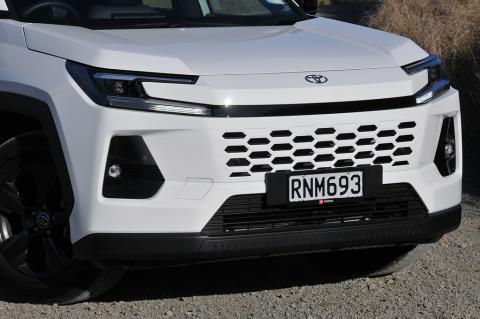
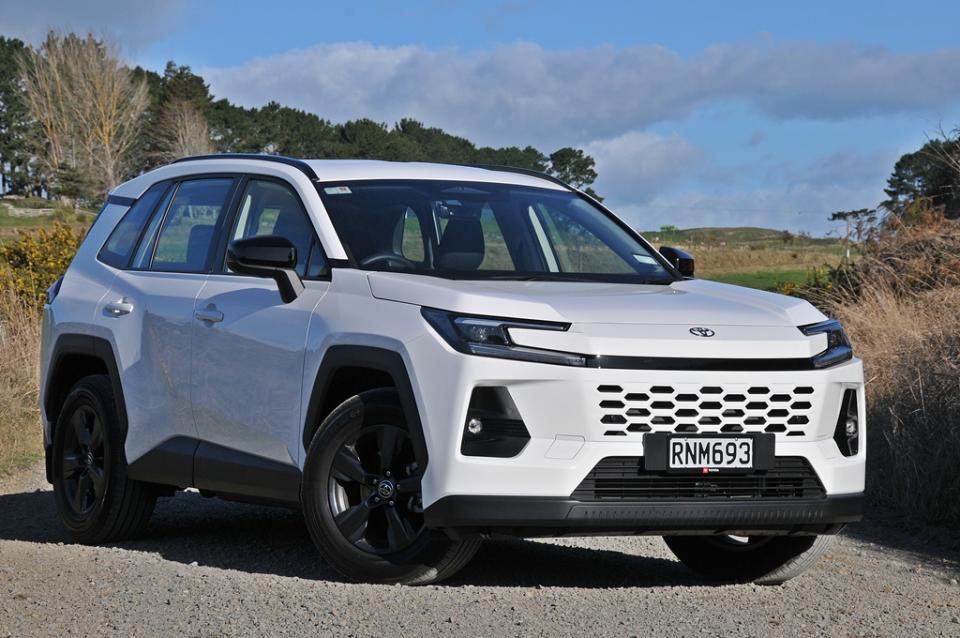
It’s the styling where the RAV4 has changed markedly compared to its predecessor – the new car features a more integrated front grille, higher-set headlights, and tougher looks all round. From the front, it has a clear ‘family’ appearance evoking the new Hilux.
It accentuates the RAV4’s status as a soft-roader within the medium SUV class.
And inside
The revamp continues on the inside, placing a strong emphasis on digital technology through a large 12.9-inch screen.
Toyota has placed some big digital real estate in the front row but it’s not at the expense of storage – there’s a neat flippable cover for the centre console box that opens from left of right and can be removed to use as a tray. There are dual cupholders, twin trays beneath the dash (including a wireless smartphone charger) and a storage slot above the glovebox.
There are big door pockets to hold even large drink bottles, plus useful nifty niches in the doors to hide small items.
RAV4 GX
We kick off a series of RAV4 drive reports with the entry-level GX grade for the refreshed medium SUV lineup.
It features a 143kW 2.5-litre fifth-generation hybrid system, 17-inch dark grey alloy wheels, dual-zone climate control, a 10.5-inch touchscreen, a 12.3-inch driver display, and wireless Apple CarPlay/Android Auto.
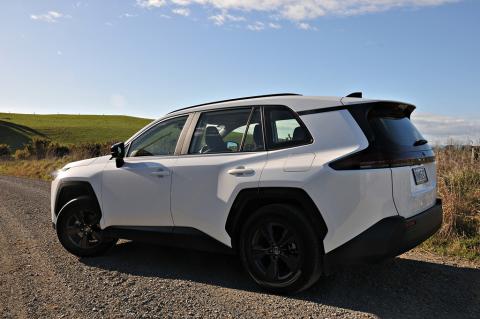
From the outside, our Glacier White drive car is a more imposing object than the fifth-generation model it replaces. Like all the new models, it has a strong ‘family’ style that aligns it with the recently launched Hilux.
With the tsunami of same-same soft SUVs arriving in New Zealand these days, Toyota has absolutely given the RAV4 what it needed: fresh, aggressive looks and a standardised drivetrain mostly based around the best set-up the RAV has ever offered.
The AWD is seamlessly capable and makes the RA4 much more of an all-road, all-weather weapon than its many rivals.
The steering is crisp and gives good mid-corner feedback. The brakes - discs at each corner - are fuss-free and reassuring in hard stops (we had a couple, Manurewa is an exciting place to drive when the locals are restless).
During our time with the GX we were invited to attend Toyota's launch of its stand-alone GR performance brand at Hampton Downs. Track time drive opportunities included seat time in the Corolla Cross, Corolla Cross GR, RAV4 and RAV4 GR. Driving any road car on a race track is instructive. The surface is smoother than 'real' roads, corners have banking and camber that 'real' roads can only dream of. But that first right over the brow at the end of the main straight is an eye-opener for anyone accustomed to commuting along State Highway 1 or the Southern Motorway. Fortunately, we tried the four SUVs in ascending order, so by the time we'd jumped into the RAV4 GR we were well into the challenge.
Confession: I did hold back down the start straight, straight, nattering with driving coach Andrew Waite. He's a real pro, raced in the open wheel Toyota Racing Series and divides his time now between events like this and drives in the GT/endurance race series.
Predictably, the RAV4 GR was our favourite. It's more than just a cute badge, is 10mm lower than the regular version and has its own suspension and steering tune. So it's more rewarding on a twisty tarmac road but gives away little of RAV4's all-road capability.
Toyota has - like most major auto brands - managed to tone down the twitchy extremes of ADAS driver awareness systems so they can be informative rather than intrusive. The driver alertness camera is there, but it's advice is a muted 'bong' rather than the 'alarm, alarm' tones of other such systems.
In summary, the GX is the range-starter, but certainly no poverty pack. Ideal for family adventures, trips to the beach or up to the snow and perfect for weekday work as well.
 ,
,