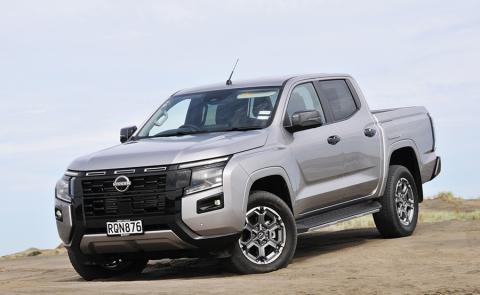
Nissan’s Navara has been part of the New Zealand landscape and lifestyle for four generations and 40 years. It transformed Nissan’s profile in rural, commercial, construction work and then became a firm favourite with families for its strength and utility.
More than 500,000 Navaras have been sold in Australia and New Zealand since 1986.
Now, the fifth generation has arrived, and we’ve driven it on – and off - New Zealand roads.
It’s a profound step away from the previous D23, and is one of the many ‘platform share’ developments present in the market this century. In fact, even earlier: Ford’s Courier was one of the first such projects, sharing mechanicals and much of its sheet metal with the equivalent Mazda ute. That Courier, in the early 1990s, was Ford’s first successful 4WD ute and went up against the Navara and Toyota’s Hilux – the latter being the absolute ruler of the 4WD ute market.
Platform shares are an important way to spread development costs while still giving manufacturers opportunity to add their own ‘flavour’ to the product. We’ve seen online griping about the joining of Nissan badging with Mitsubishi hardware, but we wonder if those outraged individuals are driving – say – a Holden Colorado (Isuzu D-Max)?
These days, most utes are platform shares between manufacturers. Ford and Volkswagen share platforms on their pick-ups, as do Mazda and Isuzu. MG and LDV platform-share their U9 and Terron utes.
So how does the D27 range look?
Nissan will only offer the new Navara in 4WD double cab wellside form - no 2WD, single cab or cab chassis models.
The D27 Navara range starts with a workhorse SL spec double cab at $54,690. It shares the same mechanicals as the rest of the range including a 2.4-litre four-cylinder twin-turbo diesel engine and six-speed automatic transmission with selectable four-wheel drive and a rear diff lock.
The switch to the Mitsubishi engine sees an increase in both power and torque over the D23, as well as a reduction in fuel consumption, while the entire Navara range inherits a five-star ANCAP safety rating. The engine produces 150kW at 3,500rpm and 470Nm of torque between 1,500-2,750rpm. Official fuel economy is listed as 7.7l/100km, and we spent a week on and off the road and got…7.7l/100km. Mitsubishi lists fuel figures for the Triton as 8.8l/km.
The whole D27 range has a 3,500kg (braked) towing rating and one tonne payload.
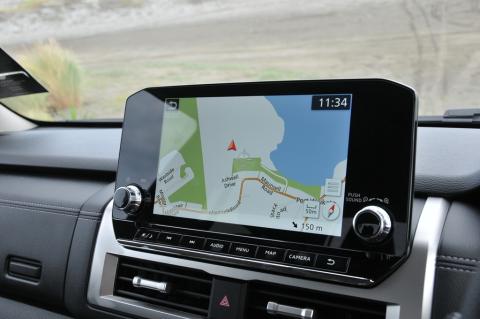
The Navara SL features an electronically controlled Intelligent Emergency Braking system (IEB) and ‘Around-View Monitor with Moving Object Detection’. The infoscreen is an 8.0" touchscreen with Apple CarPlay and Android Auto.
The ST double-cab adds 17-inch alloy wheels; LED front fog lights; privacy glass and side steps. It’s priced at $57,690.
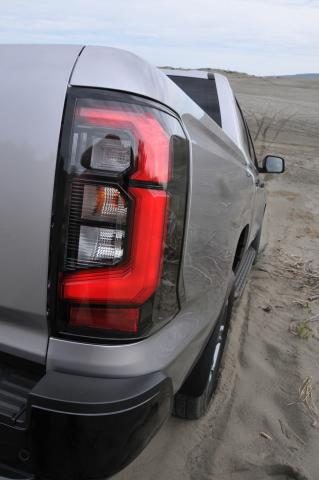
The $62,690 ST-X gets the Super 4WD system with Terrain Selector; hill descent control; 18-inch alloy wheels; Wireless phone charger and⁾ LED headlamps and rear combination lamps.
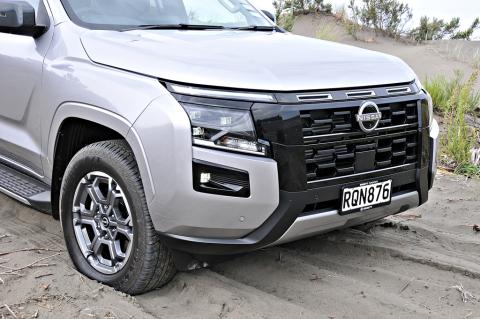
The range tops out with the Pro4-X, a more adventure-oriented model. Priced at $67,690, it gets a darkened styling theme with red accenting; leather seats with PRO-4X monogramming; 17-inch black alloy wheels with 265/65R17 all-terrain tyres and black fender flares.
The three top grades (ST, ST-X and PRO-4X) all feature Premcar-developed suspension tuned specifically for Australasian conditions. Specifically, Premcar fits new Australian-made dampers. That are bigger than Triton’s and feature an Aussie-developed internal rebound spring that improves handling, response, and more predictable pitch and roll. All without harming low-speed comfort.
And it simply works, the Navara has a measurably better on-road ride than its Mitsubishi counterpart on the road.
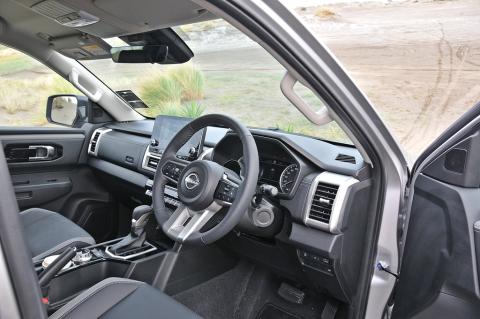
Inside, the cabin responds to the growing number of buyers who use their ute for work and family duties.
All grades feature a nine-inch multi-touch infotainment display and a seven-inch colour TFT instrument cluster, placing key vehicle information directly in the driver’s line of sight. A multi-function steering wheel has controls for cruise, Bluetooth, audio, and the driver information display keeps the most-used functions at the driver’s fingertips.
All grades feature two 12-volt power outlets — one below the climate controls and one in the rear of the centre console — along with USB-A and USB-C connectivity for device charging and media. ST, ST-X, and PRO-4X grades add dedicated rear USB-A and USB-C ports on the back of the centre console for second-row passengers.
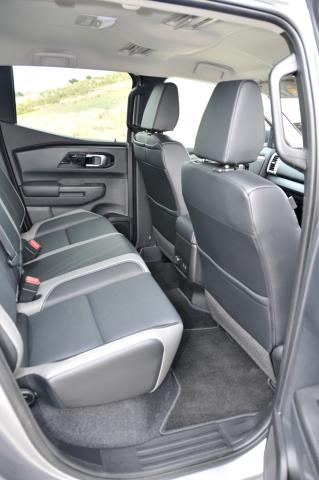
Rear air vents are standard across the range, circulating heated or cooled air to rear occupants through ceiling-mounted outlets.
Two ISOFIX anchor points and two top-tether anchor points are provided for child seat configurations.
The arrival of the D27 range is a final farewell to multiple cab options and the availability on manual transmission.
On the cost of ownership, Nissan New Zealand has launched a new ownership program that bundles an extended warranty, roadside assistance, and fixed-price servicing.
The big news is a 10 Year/300,000 kilometre warranty, activated by keeping vehicle servicing within the authorised Nissan dealer network.
It’s a step up from the standard five-year / 150,000km coverage, and it applies to all parts and components covered under the original New Vehicle Warranty, wear items excepted.
Owners need to complete all logbook services at an authorised Nissan dealer, within the scheduled intervals or inside a 60-day/3,000km window.
How’s it go, then?
Our drive vehicle is an ST-X, which might just be the ‘sweet spot’ of the range for many. The ST-X and Pro-4X models have the “Super 4WD” system that adds a Torsen centre differential that defaults to a 40:60 torque split in normal driving, with lockable 4H and 4L for more challenging conditions. There’s hill descent control and seven drive modes (Normal, Eco, Gravel, Snow, Mud, Sand, Rock).
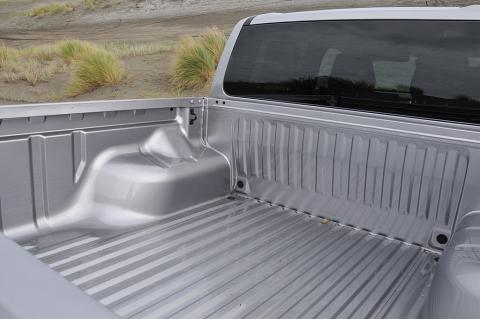
One a surprising omission from standard spec is a tray protector. Pretty much all 4WD utes need a tray protector. A towbar is likely to be a popular tick-box on the order sheet.
A key challenge for Nissan will be to differentiate the new Navara from Mitsubishi’s Triton. Key to that, for us, is the work Premcar has done on the suspension. The wheel/tyre combination is similar between the two, but the shock absorbers and springs are so much better in-sync with Kiwi roads. Where Triton can feel a little fragile over rough roads, Navara is absolutely dialled-in. The suspension, in turn, contributes to excellent communication to the driver from the seat base and steering wheel.
The new Navara’s suspension geometry reflects its focus on real-world capability. Ground clearance increases to 228mm — up 8mm over the outgoing model — while the departure angle improves to 22.8 degrees, a 2.2-degree increase that provides greater confidence when cresting obstacles and exiting steep terrain.
As a result, the ramp-over angle increases to 23.4 degrees and the approach angle of 30.4 degrees provides confident entry into steep terrain.
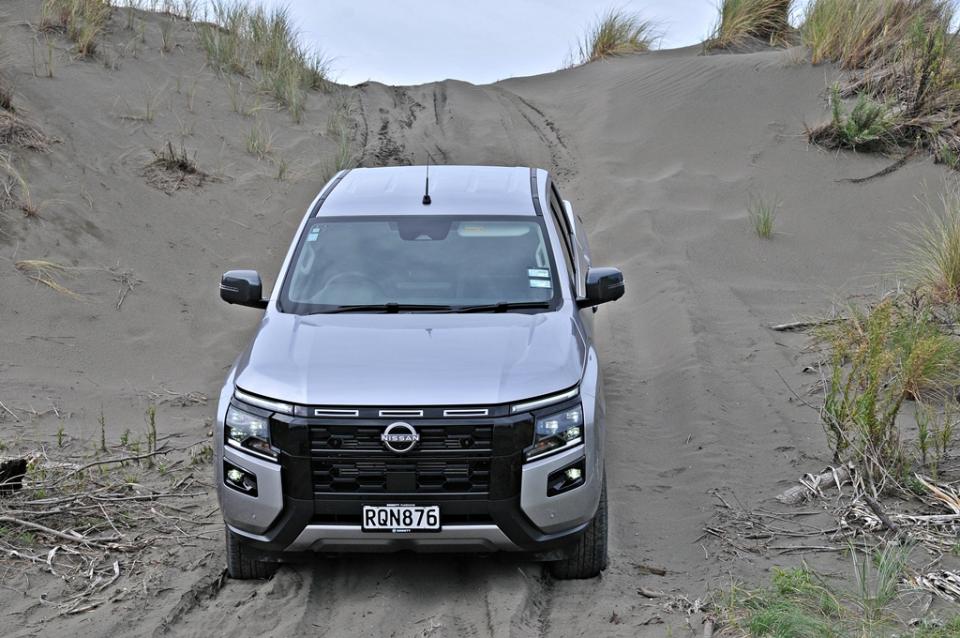
We took Navara down to Port Waikato for a ramble in the sand at the mouth of the estuary. It's an area which is open to fishing quads, dog walkers and families - not to hoons. The tracks there wind through springy native veg and off into more windswept semi-dunes near the sea.
The Navara performed well, as we had expected. Never really needed more than 4-hi, which we used mostly because it also keeps sand disturbance to a minimum. The truck's Maxxis Bravo tyres are called A/T but they actually look more of an H/T tread. Either way they were perfect for the sand work, and never even needed to be aired down.
The ST-X is good, and there is so much more to the new Navara that we're keen to try the Pro-4 next.
Conclusion
There’s a sea-change going on at Nissan.
The new Navara will shoulder much of the heavy-lifting of maintaining the brand’s profile and market position in this country.
Nissan has confirmed has confirmed the departure of the Pathfinder SUV. In urban vehicle news, the Juke and Ariya are also being canned, while the new Leaf is on 'indefinite hold'.
We may get the Frontier Pro plug-in hybrid ute.
But Navara is a flagship vehicle for Nissan as it right-sizes itself for the future, and it has definitely take a serious step forward in terms of technology and capability.
- Mark Baker
 ,
,  ,
,  ,
,  ,
,  ,
,  ,
,